TRADING GUIDE
When to exit a trade: the part nobody teaches.
Anyone can enter a trade. The result is decided at the exit — too early and you leave half the move, too late and you give it back. Here is how to decide, before you are in the heat of it.
The short answer
Exit when one of three things happens: the price hits your stop (the loss you accepted before entering), the price comes back to a gain you have already secured, or the move runs out of strength — before your target or beyond it. Write these three rules down before you enter, not after.
Why the exit matters more than the entry
Two traders can take the same entry on the same chart and end with opposite results. The difference is almost always the exit.
- Too early: you close at the first sign of a pullback and watch the price run to the target without you.
- Too late: you hope for more, the market turns, and a gain turns into a loss.
- No plan: you decide in the moment, under stress, and fear or greed decides for you.
An exit decided in advance takes emotion out of the decision. That is the whole point.
The 5 classic ways to exit a trade
1. Fixed take profit
You set a target price and close there. Simple and disciplined — but the market does not know your target: the move often stops just before it, or keeps going well after it.
2. Stop loss
The price at which you accept you were wrong. It caps the loss of each trade. Without it, one bad trade can wipe out ten good ones.
3. Trailing stop
A stop that follows the price at a fixed distance. It protects gains, but in a normal pullback it often closes the position just before the move resumes.
4. Time-based exit
You close after a set time — end of day, end of week. Useful for day traders, blind to what the market is actually doing.
5. Market structure
You exit on a support or resistance, a moving average or a pattern. Effective, but it takes experience and screen time to read in real time.
The 4 exit mistakes that cost the most
- Moving the stop further away when the price comes close to it. The loss grows and the plan disappears.
- Cutting gains short and letting losses run — the opposite of what builds results.
- No rule for the gains already made: a trade at +1% that ends at −1% hurts twice.
- Not being there at the right moment: the exit happens while you are in a meeting, asleep or away from the charts.
How Ticks decides the exit
Every Ticks strategy comes with its exit plan, and Genius AI follows it in real time:
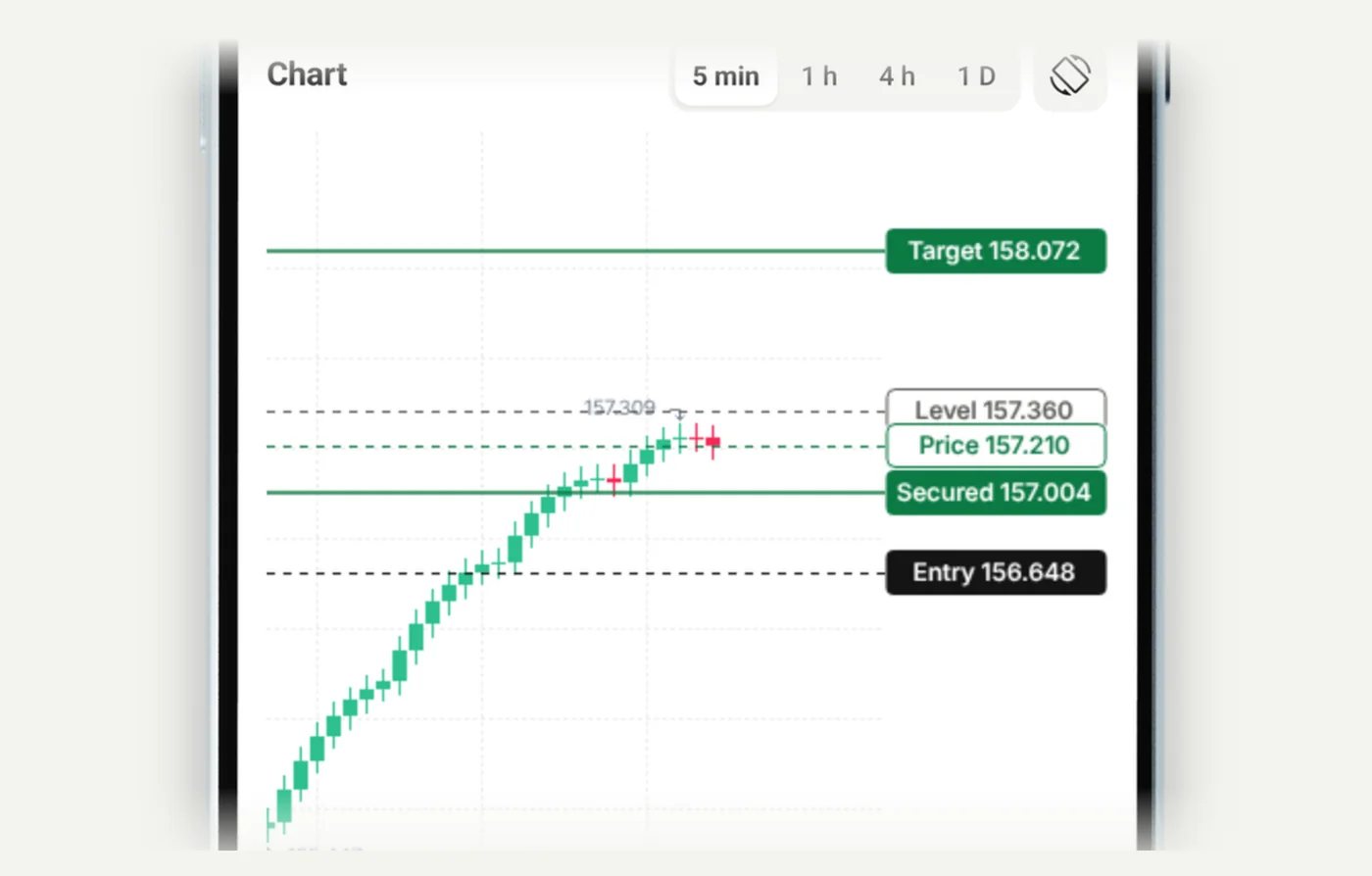
- The stop is the maximum accepted loss. It protects the strategy between the entry and the first level.
- The levels are placed every 25% of the distance between the entry and the target: 25%, 50%, 75%, 100%, then beyond.
- Each level crossed is secured (the padlock): if the price comes back to it, the strategy closes with that gain. From then on, the stop is no longer used.
- The ratchet: the protection moves up one notch per level crossed, never moves back, and has no ceiling.
- The exit is decided by Genius AI — before the target or well beyond it. The target is a reference used to place the levels, not a fixed exit.
The stop does not follow the price continuously: it is the levels, crossed one by one, that secure the gain. See it on the strategy detail and the ratchet in the glossary.
A real example: USD/JPY Long
The strategy shown in the app: entry 156.648, target 158.072, stop 155.699. Risk / reward 1 : 1.5.
| If the price… | Exit | Result |
|---|---|---|
| falls to the stop before the first level | 155.699 | −0.61% |
| crosses 25%, then comes back | 157.004 | +0.23% |
| crosses 50%, then comes back | 157.360 | +0.45% |
| crosses 75%, then comes back | 157.716 | +0.68% |
| reaches the target and keeps going | decided by Genius AI | +0.91% secured, and more |
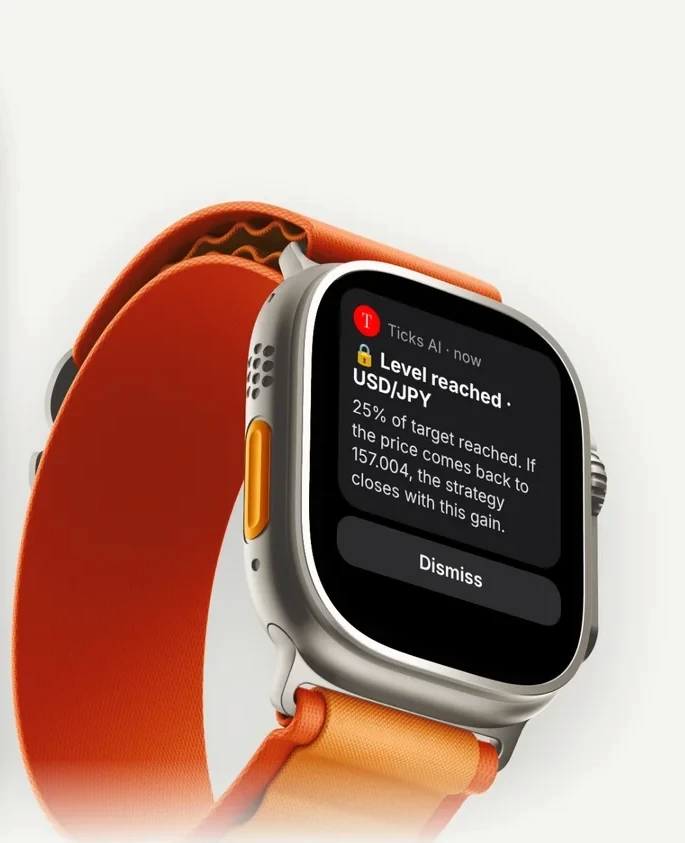
At each step you receive a notification — on your phone and on your wrist: Level reached — if the price comes back to 157.004, the strategy closes with this gain. You always know where you would get out, before it happens. How notifications work: the notifications guide.
Questions about exiting a trade
What is the best exit strategy in trading?
The one you decide before entering and apply without emotion. In practice, the most robust combinations cap the loss with a stop, then secure the gain step by step as the price moves in your favour, rather than betting everything on a single take profit.
Should I always use a stop loss?
Yes. The stop is the loss you accept before entering. Without it, a single trade can erase many good ones. In Ticks, every strategy has its stop, shown on the card and on the chart.
Is the target the exit price?
Not in Ticks. The target is a theoretical price used to place the levels. Genius AI decides the exit, which can come before the target or well beyond it.
What is a secured level?
The last level the price has crossed, marked with a padlock. If the price comes back to it, the strategy closes with that gain. Each new level crossed replaces it, and it never moves back.
Can I be notified when it is time to exit?
Yes. Ticks notifies you when a strategy is found, when the entry is reached, each time a level is crossed and at the exit — on iPhone, iPad, Android and Apple Watch.