TRADING GUIDE
Where to place a stop loss: where your idea is proven wrong.
The stop loss is the only part of a trade you fully control. Placed well, it caps the loss and lets you size the position. Placed badly, it closes good trades in the noise — or protects nothing at all.
The short answer
Place your stop where your trade idea is proven wrong — beyond the last swing low for a Long, beyond the last swing high for a Short — not at a random percentage. Then size the position so that this distance costs a loss you accept, and never move the stop further away.
What a stop loss is really for
- It caps the loss of each trade, so that no single trade can wipe out the others.
- It decides before emotion does: the exit on a bad trade is set when you are calm, not when the price is moving against you.
- It makes the position size computable: without a stop, you cannot know what the trade puts at risk.
4 ways to place a stop loss
1. Fixed percentage
The stop sits at, say, 2% from the entry. Easy, but it ignores the market: 2% is huge on a currency pair and tiny on a volatile crypto.
2. Volatility
The stop is a multiple of the asset's average range (ATR, for example 1.5 to 2 times). It adapts to each market and keeps the stop outside normal noise.
3. Market structure
The stop goes just beyond the level that invalidates the trade: below the last swing low or a support for a Long, above the last swing high or a resistance for a Short. It is the most logical — and the one professionals use most.
4. Fixed amount
You stop at, say, 100 dollars of loss. It suits your budget, not the chart: the stop ends up wherever the money runs out, often in the middle of the noise.
5 stop-loss mistakes to avoid
- A stop too tight, inside the normal swings of the asset: you are stopped out, then the price goes your way.
- A stop on an obvious round number (1.1000, 70,000): that is where many orders sit and where the price often comes to look.
- Moving the stop further away when the price gets close. The loss grows and the plan disappears.
- The “mental” stop you will place “if needed”. Under pressure, it is rarely applied.
- A stop with no link to the position size: the same distance does not carry the same risk on a small and a large position.
How Ticks sets and uses the stop
Every Ticks strategy comes with its stop, computed by Genius AI together with the entry and the target:
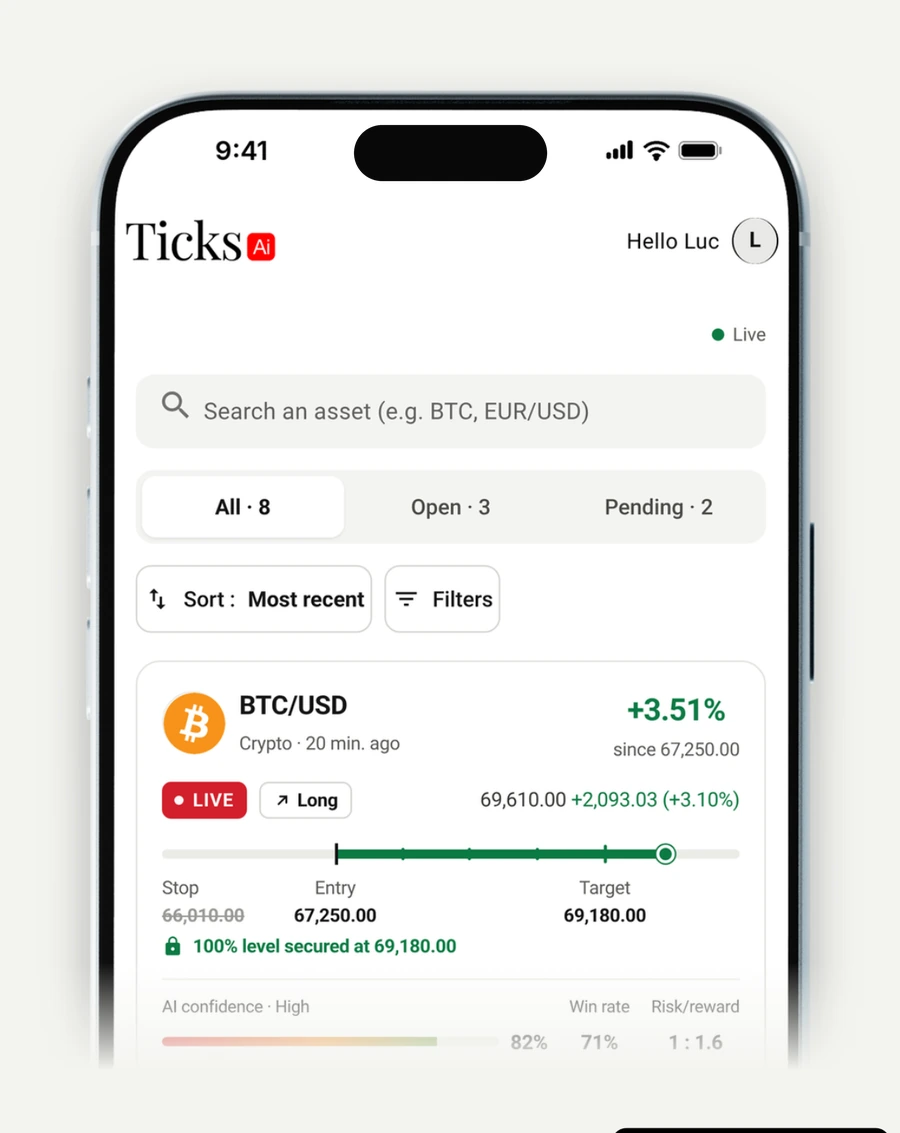
- Visible before you act: the stop is on the card, on the bar and on the chart, with the risk / reward of the setup.
- It protects until the first level: between the entry and the first level, the stop is the maximum accepted loss.
- Then the levels take over: as soon as a level is crossed, it is secured and the stop is no longer used — the app shows it crossed out.
- The ratchet never moves back: each new secured level replaces the previous one, and the protection only moves up, level by level. See the ratchet and the strategy detail.
Example: BTC/USD Long
The strategy on the screen: entry 67,250, stop 66,010, target 69,180. Risk / reward 1 : 1.6. The levels sit every 25% of the 1,930-point distance to the target.
| Level crossed | Worst possible exit | Result |
|---|---|---|
| none yet (stop active) | 66,010 | −1.84% |
| 25% level | 67,732.50 | +0.72% |
| 50% level | 68,215 | +1.43% |
| 75% level | 68,697.50 | +2.15% |
| 100% level (on the screen) | 69,180 | +2.87% |
On the screen, the price is at 69,610: the 100% level is secured and the stop is crossed out. From there, the worst case is no longer a loss but +2.87%.
Questions about the stop loss
Where should I place my stop loss?
Where your trade idea is proven wrong: just beyond the last swing low for a Long, or the last swing high for a Short, outside the normal swings of the asset. Then size the position to that distance.
What percentage should a stop loss be?
There is no single right percentage: it depends on the asset's volatility. What should be fixed is the amount you accept to lose per trade, often 0.5% to 2% of your capital. The stop distance then sets the position size.
Should I move my stop loss?
Never further away. In Ticks, the stop stays where it is: once the first level is crossed, it is no longer used and the levels take over. Each level crossed is secured with a padlock, and the ratchet never moves back.
Is a mental stop loss enough?
Rarely. Under pressure, a stop that is not placed is often not applied. In Ticks, every strategy shows its stop before you enter, and you place it at your broker.
Does every Ticks strategy have a stop?
Yes. The stop, the entry, the target and the levels are computed by Genius AI and shown on the card and on the chart, with the risk / reward.