TRADING GUIDE
Position size: the stop decides, not your conviction.
Two traders take the same trade. One risks 1% of the account, the other 10%. Same idea, opposite futures. Position size is what lets you survive the losing streaks — and still be there for the good trades.
The short answer
First decide how much you accept to lose on the trade — for example 1% of your capital. Measure the distance between the entry and the stop. Then divide: position size = amount at risk ÷ stop distance. The stop sets the size, not the other way round.
Why position size matters more than you think
Losses do not weigh the same as gains. The deeper the drawdown, the harder the climb back:
| Loss on the account | Gain needed to get back to even |
|---|---|
| −10% | +11.1% |
| −20% | +25% |
| −50% | +100% |
With small positions, a run of losses stays a scratch. With large ones, it can end the account. Size is the first protection, before any strategy.
The formula, step by step
- Amount at risk: capital × risk per trade. With 10,000 and 1%: 100.
- Stop distance: entry − stop. On the BTC/USD strategy (entry 67,250, stop 66,010): 1,240 points, i.e. 1.84%.
- Position size: amount at risk ÷ stop distance. 100 ÷ 1,240 ≈ 0.081 BTC, i.e. about 5,420 of exposure.
Check: 0.081 BTC × 1,240 points ≈ 100. If the stop is hit, the loss is the one you chose — no more.
A stop twice as far away means a position half as big, for the same risk. That is why a wide stop is not a problem in itself: only the size has to follow.
The usual ways to size a position
Fixed risk per trade
A constant share of the capital (often 0.5% to 2%) is put at risk on each trade, and the size is computed from the stop. It is the reference method.
Fixed lot
Always the same quantity. Simple, but the risk changes with every stop distance: some trades risk much more than others.
Fixed share of capital
Each position weighs, say, 10% of the account. Easy to read, but it ignores where the stop is.
Volatility-based
Smaller positions on the most volatile assets. Close to the fixed-risk method, when the stop itself follows volatility.
4 sizing mistakes to avoid
- Sizing by conviction: “this one is sure, I go big”. The market does not know how sure you are.
- Doubling after a loss to win it back faster. One more loss and the account takes a blow it cannot absorb.
- Confusing leverage and risk: leverage changes the capital you tie up, not the loss at the stop. The risk is set by the size and the stop distance.
- Forgetting correlated trades: EUR/USD Long and GBP/USD Long at the same time is largely the same bet against the dollar — twice the risk.
How Ticks shows the position size
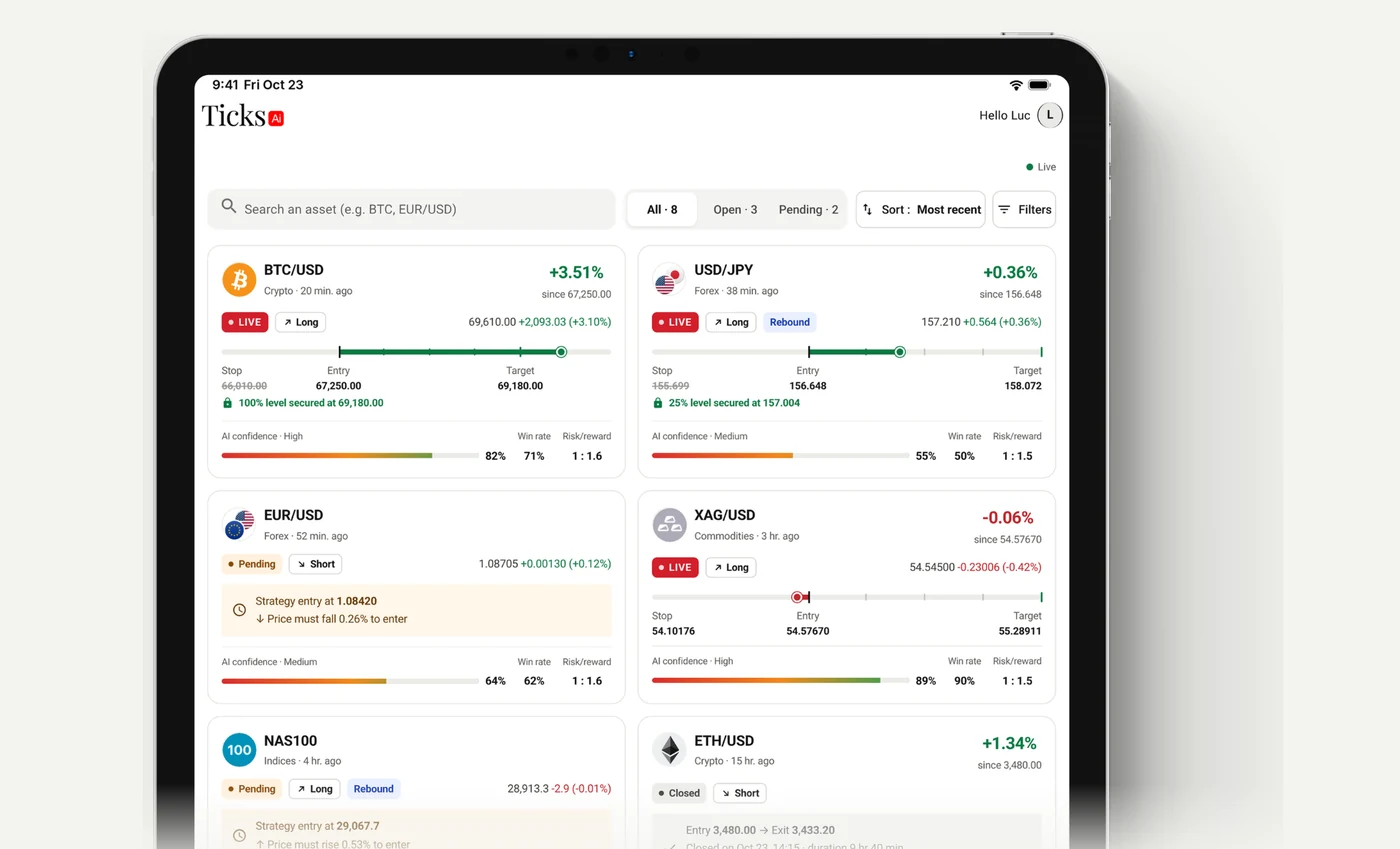
- A suggested size on every strategy: Genius AI gives the share of your available buying power to commit, in %.
- Next to the stop, the entry and the target, with the AI confidence, the win rate and the risk / reward: everything you need to size the trade is in the strategy detail.
- You stay in control: Ticks does not know your capital and places no orders. You apply the size at your broker, within your own risk per trade.
- Results in %: every result is shown in % from the entry, so it reads the same whatever the size of your account.
Questions about position size
How much should I risk per trade?
Often 0.5% to 2% of your capital. The lower the risk per trade, the longer you hold through a run of losses. Many traders start at 1%.
What is the 1% rule?
Never risk more than 1% of your capital on a single trade: the loss at the stop must not exceed that amount. The position size is then computed from the stop distance.
Does leverage increase my risk?
Not by itself. Leverage reduces the capital you tie up. The risk is set by the position size and the stop distance: the same size and stop give the same loss, with or without leverage.
How does Ticks suggest a position size?
On every strategy, Genius AI shows a suggested size as a % of your available buying power. You apply it to your own capital at your broker: Ticks does not need to know it.
Should I increase my size after a winning streak?
Keep the same risk per trade as a % of the capital. As the account grows, the amount at risk grows with it — gradually, without changing the rule.